Reuse workshop / Beginner / Measure before cutting
A Second Life for Scraps
A clean delivery box becomes a removable divider for a drawer of light everyday supplies.
Make the material earn its space
Corrugated cardboard is useful because its layers provide stiffness without much weight. Two interlocking strips can divide a shallow drawer into four sections. This is a practical home for stationery, thread spools or small accessories, not a structural shelf or a liner for damp items.
Choose a clean, dry box with flat panels. Remove staples carefully and peel away loose tape. Avoid grease-stained takeaway boxes, mouldy board and packaging that held chemicals. Reusing an unsuitable material is not worth the cleaning effort or the uncertainty.
- A clean corrugated cardboard panel
- A ruler, pencil and scissors that cut the board comfortably
- Scrap paper for a measurement plan
- Optional thin kraft paper and suitable PVA glue
- A protected work surface for any gluing
Design for your drawer
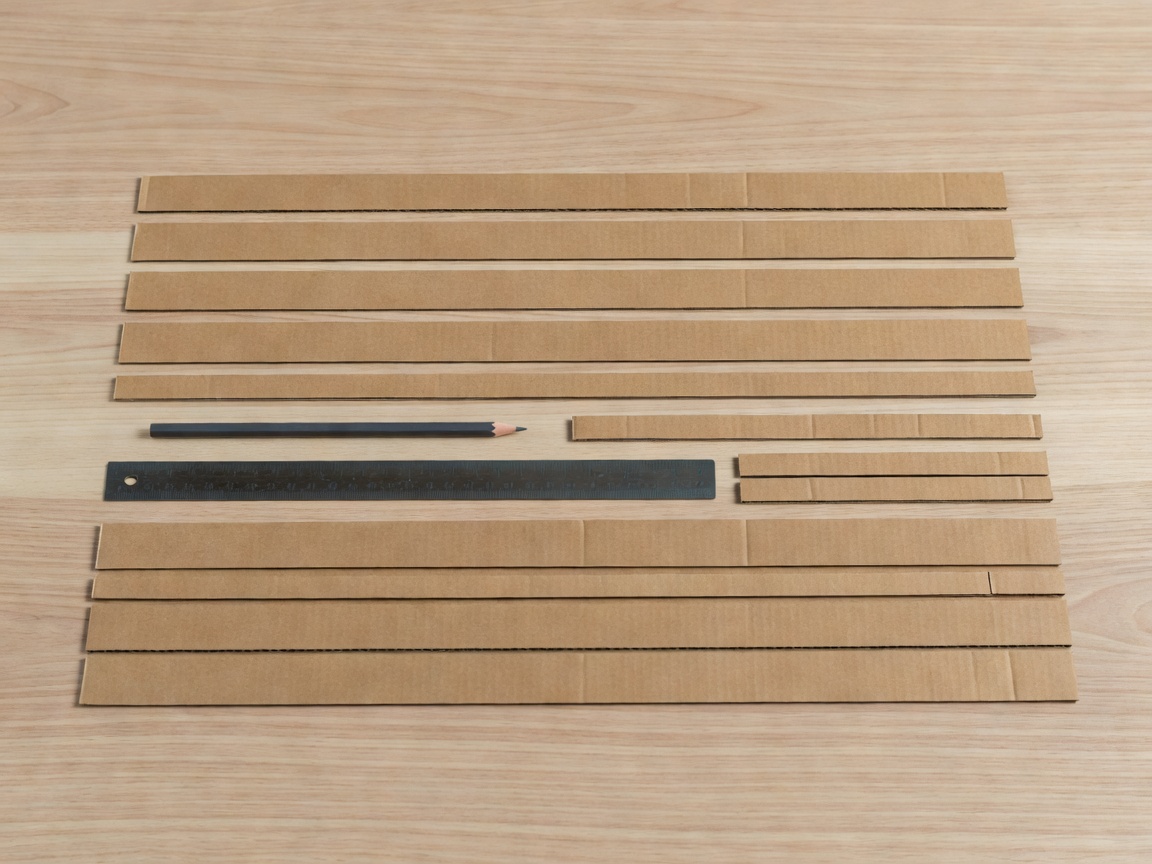
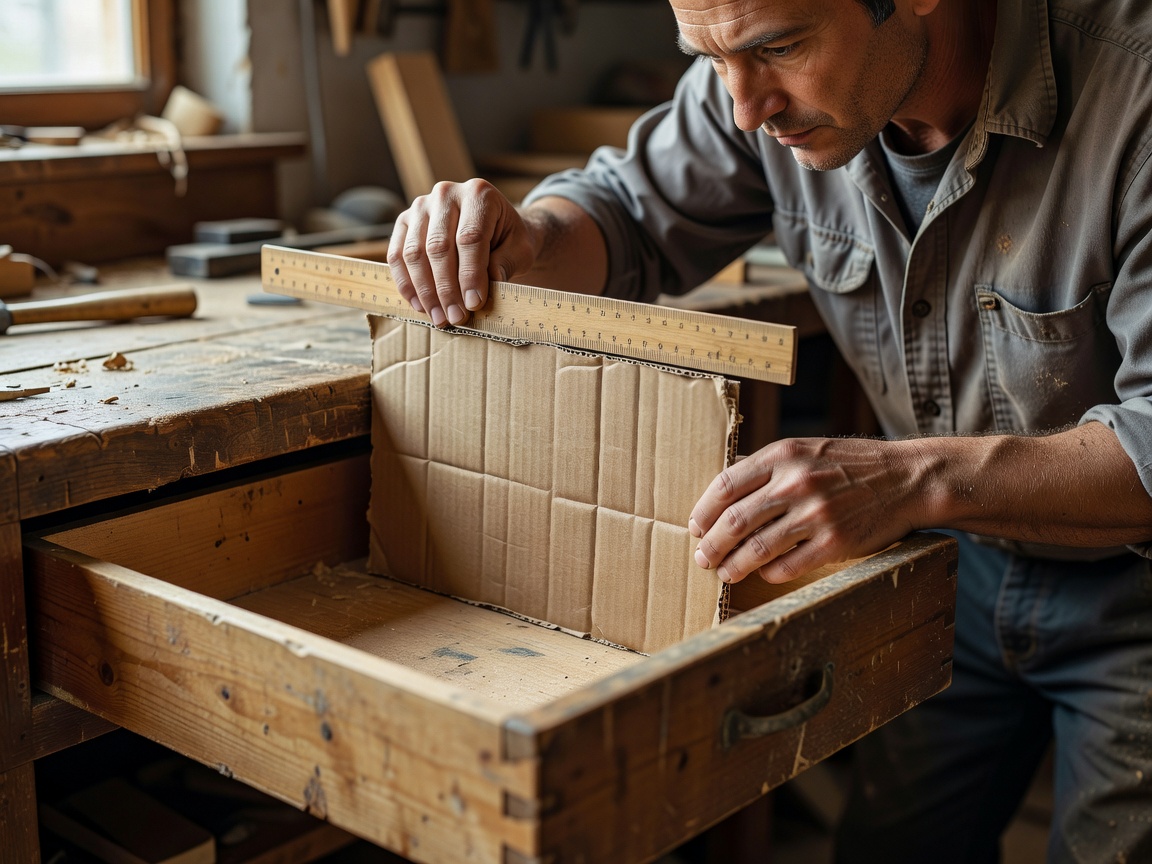
Empty the drawer and measure its internal width, depth and usable height. Check for runners, screws or a curved back that reduce the space. Make the divider slightly shorter than the usable height so the drawer can close without scraping.
For a simple cross, one strip spans the drawer width and the other spans its depth. Leave a little clearance at each end: the insert should lift out without bending. A paper test strip helps you check the fit before using your best panel. If the board has visible channels, arrange them vertically within the finished strips where practical to improve upright stiffness.
Build an interlocking cross
Mark two strips
Draw one rectangle matching the drawer width and another matching its depth, allowing clearance. Both need the same height. Use a straight reference edge and mark the dimensions in pencil. Keep away from crushed box folds, which tend to buckle.
Cut without forcing
Use scissors only if they pass through the board comfortably. Take short cuts and turn the material, keeping your supporting hand out of the cutting path. If the cardboard is too thick, find thinner board rather than forcing the blades. Craft knives require a proper cutting mat and suitable experience; they are not necessary for this beginner version.
Mark matching slots
Mark the midpoint along each strip. Draw a slot as wide as the cardboard is thick and extending halfway through the strip height. One slot opens from the top edge; the other opens from the bottom. Test the width on a scrap because compressed cardboard can be thinner than it first appears.
Cut and join
Cut each slot carefully, removing the narrow waste piece. Slide the two strips together at right angles. Their top edges should align. If they stop short, check the slot depth; if they wobble, the slots may be too wide. A new test strip is often neater than trying to repair a large gap.
Test in the drawer
Place the cross inside and add a few lightweight items. Open and close the drawer slowly. Trim any edge that catches, and check that the cardboard stays upright when the drawer moves. The insert should be removable, not wedged tightly into the furniture.
Finish only if needed
Plain board is a valid finish. For a covered version, take the cross apart and apply thin kraft paper with a light, even layer of compatible PVA glue. Avoid filling the slots. Let the pieces dry fully, flat between non-stick protective layers under light, evenly distributed weight, then reopen the slots and reassemble.
Substitutions that make sense
| Material | Useful role | Limit |
|---|---|---|
| Corrugated box board | Upright dividers | Needs dry surroundings |
| Cereal-box card | Labels or light surface covers | Too flexible for tall dividers alone |
| Paper shopping bag | A thin decorative covering | Remove handles and thick seams |
| Clean fabric scrap | A loose drawer liner | Can catch small items; keep washable |
Use the scraps, then stop collecting
Small offcuts become label tabs or glue-test pieces. Keep only a modest supply you can store flat and dry. Printed packaging does not need disguising if it will live inside a drawer. Spending money on paint, sealant and elaborate trim can defeat the point of this project.
Other easy reuse ideas include a clean glass jar as an unheated pencil pot and a paper bag as gift wrap. Check glass for chips and cracks; do not turn an unknown jar into a candle holder or assume it tolerates heat. Remove paper labels by a method suitable for the container, and let it dry completely before use.
When the divider wears out, local recycling rules determine whether covered or glued board is accepted. The US Environmental Protection Agency explains general recycling principles, while Recycle Now provides UK guidance. Check your local collection rules rather than assuming every mixed-material craft belongs in paper recycling.